1
Paste your Markdown
Paste an AI answer, README, note, or any other Markdown source.
Convert Markdown to Text for clean plain text, or copy rich text into Word and Google Docs with formatting preserved.
Drop Markdown files here or
Open several documents at once, paste Markdown, or start with an empty editor. Each file becomes a document in the list.
Converted in your browser — nothing is uploaded
The Markdown to Text converter removes syntax while preserving readable structure. Choose plain text for everyday apps or rich text for formatted pasting.
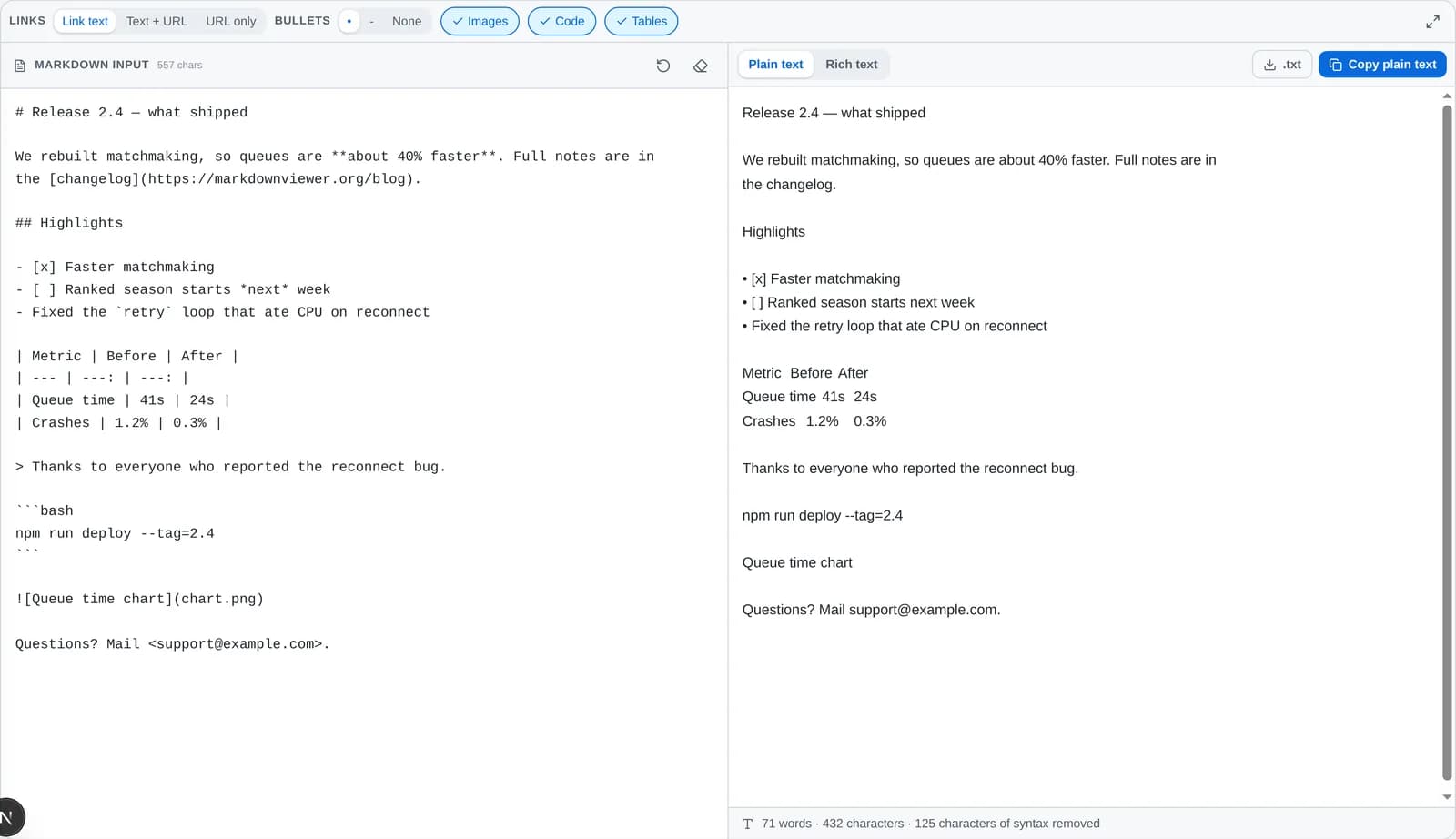
A structured parser identifies Markdown elements before the converter applies your output rules and rebuilds readable spacing.
## Highlights

- Fixed the `retry` loop
- See the [changelog](https://example.com/blog)

> Thanks to everyone who reported it.Highlights
• Fixed the retry loop
• See the changelog
Thanks to everyone who reported it.See how common Markdown elements become clean, readable text.
| Markdown | Becomes | Notes |
|---|---|---|
# Heading | Heading | The hashes go; the line stays on its own so the document keeps its shape. |
**bold** *italic* | bold italic | Asterisks and underscores are unwrapped, including ***both*** and ~~struck~~. |
[label](https://…) | label | Or “label (https://…)” or the bare URL — your choice in the Links control. |
 | alt | Alt text is words, so it is kept by default. Switch Images off to drop it. |
- item / 1. item | • item | Choose a bullet, dash, or no marker. Indentation and task states stay readable. |
> quoted | quoted | The quote marker goes; the quoted sentence stays where it was. |
`code` and ```blocks``` | code | Backticks are removed and the code itself is kept — or dropped entirely. |
| a | b | | a⇥b | Cells become tab separated, which pastes into a spreadsheet as columns. |
\*escaped\* | *escaped* | An escaped character was always meant to be literal; the backslash goes. |
  & | space & | HTML entities and inline tags are decoded and stripped. |
Paste your source, choose the output, then copy or download the result.
Paste an AI answer, README, note, or any other Markdown source.
Select plain or rich text, then adjust links, images, bullets, code, and tables.
Copy the Markdown to Text result or download clean plain text as a .txt file.
Clean Markdown for AI output, everyday apps, speech tools, and content processing.
Remove visible Markdown markers from ChatGPT or Claude output before pasting it into email, support tools, or forms.
Turn Markdown into readable text for apps that do not render headings, emphasis, links, or lists.
Give speech engines clean prose without asterisks, hashes, backticks, or long link URLs.
Use Markdown to Text as a cleanup step before indexing, comparing, or counting content.
Answers about plain and rich text, AI output, links, tables, .txt export, and local privacy.
Paste Markdown and copy clean plain text or formatted rich text in seconds.