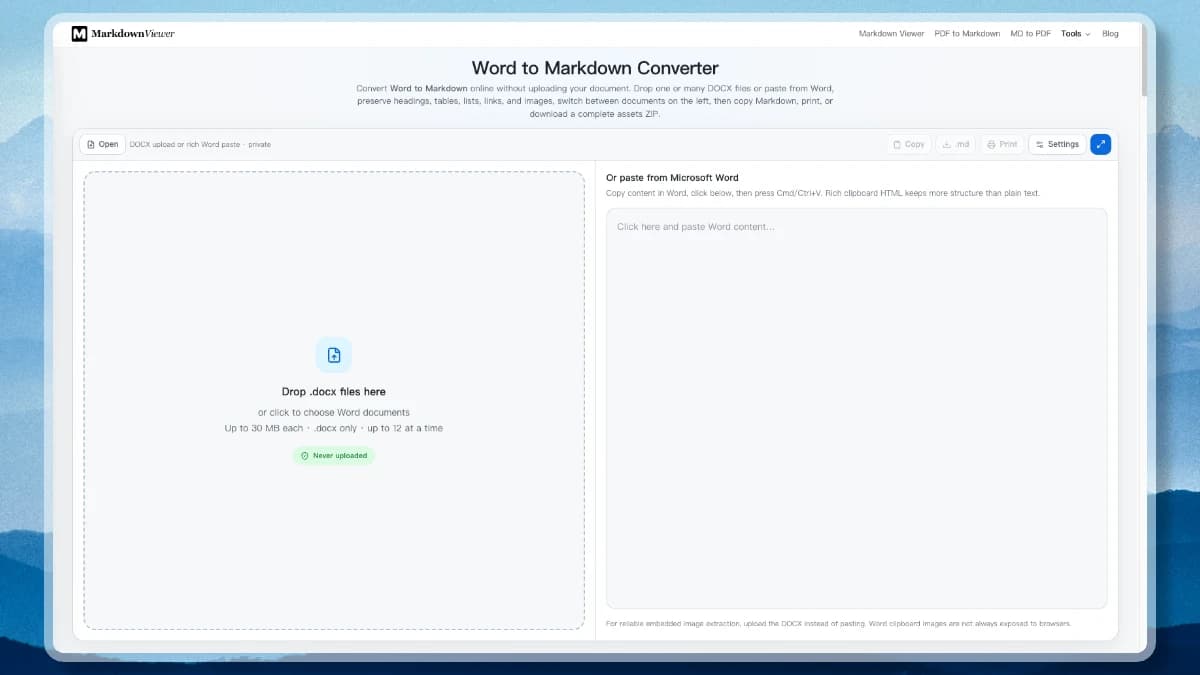
Word to Markdown Converter

Convert Word to Markdown online without uploading your document. Drop one or many DOCX files or paste from Word, preserve headings, tables, lists, links, and images, switch between documents on the left, then copy Markdown, print, or download a complete assets ZIP.

Or paste from Microsoft Word

Copy content in Word, click below, then press Cmd/Ctrl+V. Rich clipboard HTML keeps more structure than plain text.

For reliable embedded image extraction, upload the DOCX instead of pasting. Word clipboard images are not always exposed to browsers.

The Word to Markdown converter with a document list on the left, converted Markdown in the middle, and the conversion settings panel open on the right.
Document tabs, converted Markdown, and the conversion settings panel.

What Is the Word to Markdown Converter?

The Word to Markdown converter reads a DOCX file in your browser and rewrites its structure as clean Markdown. Headings, lists, tables, links, and embedded images come across — and the original file never leaves your device.

  • A batch at a time: Open several .docx files or drop them on the page; each conversion becomes a tab in the document list on the left.
  • One panel for every setting: Image handling, LLM clean mode, links, and merged-table behavior live in the settings panel, applied to one document or all of them.
  • Reusable presets: Save a settings combination as a named preset and load it on the next batch instead of re-picking every switch.
  • Markdown, ZIP, or print: Copy the Markdown, download a .md file, export Markdown plus an assets/ folder as a ZIP, or send the rendered result to your printer.

Word to Markdown Built for Real Documents

The converter handles Word structure, not just visible text. It also gives image packaging and cleanup choices that make the result practical for GitHub, knowledge bases, static sites, and AI pipelines.

DOCX to Clean Markdown

Word to Markdown maps real Word heading styles, paragraphs, emphasis, links, quotes, lists, and code styles to readable GFM instead of scraping visible text.

Word to Markdown with Images

Extract embedded images to an assets folder and download one ZIP, embed images as data URLs, or omit them for a text-only Word to Markdown result.

Tables and Nested Lists

Standard Word tables become editable Markdown tables. The Word to Markdown converter preserves merged tables as safe HTML when flattening them would lose structure.

LLM and RAG Clean Mode

Word to Markdown removes document chrome and converts Office structure into compact headings, lists, and tables that are easier to chunk, inspect, and send to an AI pipeline.

DOCX Upload or Word Paste

Drop a .docx for reliable structure and image extraction, or paste rich content copied from Word for a fast Word to Markdown conversion without saving an intermediate file.

Split View With Synced Scrolling

Read the generated Markdown beside its rendered form with both panes scrolling together, or switch to Markdown-only to edit and Preview-only to check the result.

A Batch of Documents at Once

Open up to twelve .docx files, switch between them in the list on the left, close any you are done with, and apply conversion settings to one document or to all of them.

Honest Conversion Notices

When Word uses a style with no Markdown equivalent, the converter says so in a dismissible notice instead of silently dropping it — the text is kept, and you decide whether the styling mattered.

Private Offline Processing

Word to Markdown parsing, image extraction, preview, and ZIP creation run locally after the app loads. The document is not sent to a conversion API or stored by this site.

Convert Word to Markdown in 3 Steps

Move from a DOCX or rich clipboard selection to editable Markdown and portable image assets without installing a desktop application.

1

Drop a DOCX or paste from Word

Start Word to Markdown by choosing a modern .docx file, dragging it into the converter, or pasting rich clipboard content copied from Microsoft Word.

2

Choose image and cleanup rules

Select an assets ZIP, embedded data URLs, or no images. Then configure Word to Markdown link handling, LLM clean mode, and merged-table preservation — for this document or for every open document at once.

3

Review, copy, or download

Split view scrolls the source and preview together while you check the conversion, and the word, heading, table, and image counts sit beside the file name. Then copy the Markdown, download one .md file, print it, or save Markdown and extracted images together as a ZIP.

Move Word Knowledge Bases into Git-Friendly Markdown

DOCX is a zipped collection of XML and media files. Git can store it, but reviewers cannot read a useful line-by-line diff when one paragraph changes. Word to Markdown turns document hierarchy into plain text that GitHub, GitLab, Docusaurus, Astro, Hugo, Obsidian, and code review tools can inspect.

A migration still needs decisions: map Word heading styles consistently, choose stable image paths, repair internal links, and review complex tables. Keep original documents until the Word to Markdown output, assets, references, and navigation have been verified in the destination system.

DOCX → Git workflowREVIEWABLE
SourceVersioned DOCX kept as migration evidence
ContentHeadings, lists, links, tables, code
MediaStable assets/ paths in one ZIP
ReviewReadable diffs and preview checks

Word to Markdown with Images and Tables

Images and complex tables are where a simplistic Word to Markdown converter usually becomes inconvenient. This tool makes the trade-offs visible before export.

Assets ZIP

The recommended Word to Markdown image mode extracts binary media, writes assets/image-001.png style paths, and packages Markdown plus images together.

Embedded data URLs

A self-contained Word to Markdown file can embed image bytes directly. It is portable but much larger and less pleasant to review in Git diffs.

Safe table handling

Simple tables become GFM. Merged or nested tables remain sanitized HTML when that preserves more meaning than a flattened Markdown grid.

LLM/RAG preparation checklist
Use semantic headings rather than visual font size
Remove navigation and irrelevant document chrome
Keep table headers and meaningful link labels
Decide whether images need OCR or human captions
Chunk after conversion, not inside DOCX XML
Retain source IDs for citations and traceability

Clean Word Documents Before LLM and RAG Ingestion

Sending raw DOCX bytes to a model forces another system to unpack Office XML, relationships, style definitions, and embedded media. Word to Markdown creates an inspectable intermediate format where headings, lists, paragraphs, and tables are explicit before chunking or embedding.

Word to Markdown does not magically understand screenshots, diagrams, or decorative layout. If image meaning matters, add alt text, run a reviewed OCR or vision step, and keep the image beside the Markdown. Clean text saves noise, while provenance and human review protect retrieval quality.

What Word to Markdown Cannot Carry Over

Markdown is a smaller format than Word on purpose. Knowing what it drops tells you what to check after a conversion — and when to keep the .docx as the source of record.

Merged and nested tables

GFM has no colspan or rowspan, so a merged table is preserved as sanitized HTML instead of being flattened. Turn that option off if your target renderer refuses inline HTML, and expect to rebuild the table by hand.

Word-only document features

Comments, tracked changes, footnotes, captions, headers and footers, fields, and text boxes have no Markdown equivalent. Resolve or export them in Word first if they carry meaning.

Legacy and confidential archives

Binary .doc files must be re-saved as .docx before conversion. For a large or sensitive migration, a scripted local pipeline gives you version pinning, per-file logs, and an audit trail this tab cannot.

Word to Markdown Stays in Your Browser

Word to Markdown reads DOCX XML, extracts embedded media, builds Markdown, renders the preview, and creates the ZIP on your device. There is no document upload, conversion queue, account, or server-side file retention.

No sign-upNo document uploadNo watermark

Word to Markdown Frequently Asked Questions

Practical answers about DOCX, old .doc files, images, tables, Word paste, batch conversion, conversion notices, and privacy.

How do I convert Word to Markdown online?
Drop a .docx file into the converter or choose Open. The browser reads the Word structure, generates Markdown, and shows an editable source beside the rendered preview. Copy the result, download .md, print it, or save Markdown and images as a ZIP.
Can I paste from Word instead of uploading a file?
Yes. Copy a selection in Microsoft Word and paste it straight into the converter — the rich clipboard content keeps headings, emphasis, links, lists, and tables. Upload the .docx itself when you need reliable image extraction, because Word's clipboard often references images the browser cannot read.
Can I convert several Word documents at once?
Yes. Open up to twelve .docx files and each becomes a tab in the document list on the left, with its own converted Markdown. Switch the settings panel to All documents to apply image handling, clean mode, or link rules to every file, and close a tab when you are finished with it.
Can I batch convert Word to Markdown for GitHub?
Open up to twelve .docx files at once, apply the same image and cleanup rules to all of them, and download each result with its assets folder. Keep the original documents, write the Markdown to its own directory, and review internal links and complex tables before committing to Git. For a migration of hundreds of files, a scripted local pipeline gives you per-file logs and an audit trail that a browser tab cannot.
Can Word to Markdown preserve images?
Yes. The recommended mode extracts embedded images to an assets folder and updates Markdown image paths, then downloads everything in one ZIP. You can instead use data URLs for a single self-contained Markdown file or remove images.
Why are pasted Word images missing?
Word clipboard HTML sometimes references temporary local images without exposing their bytes to the browser. Upload the original .docx when reliable image extraction matters.
Does Word to Markdown preserve tables?
Standard tables become GFM pipe tables. Tables with merged, nested, rowspan, or colspan cells can remain as sanitized HTML because ordinary Markdown has no lossless representation for those structures.
What do the conversion notices mean?
They list Word styles that have no Markdown equivalent — a custom 'Body Text' or 'First Paragraph' style, for example. The text is always kept; only the styling is dropped. The notice is informational, so you can dismiss it, and it returns if you change a setting and re-convert.
Can I convert an old .doc file?
Not in this browser converter. Legacy .doc is a binary format rather than the zipped XML structure used by .docx. Open the document in Word or LibreOffice, save it as .docx, then convert that file.
Do I need to install anything to convert Word to Markdown?
No. The Word to Markdown converter runs in the browser on Windows, macOS, Linux, and ChromeOS, with no account, extension, or desktop application to install. After the page loads, DOCX parsing, image extraction, and ZIP creation keep working without a network connection.
Is this Word to Markdown converter private?
Yes. DOCX parsing, Markdown conversion, embedded image extraction, preview rendering, and ZIP creation run locally in your browser. Your Word file is not uploaded to an application server.

Convert Word to Markdown Now

Return to the private converter, drop a DOCX or paste Word content, choose image handling, and download clean Markdown with its assets.